 |
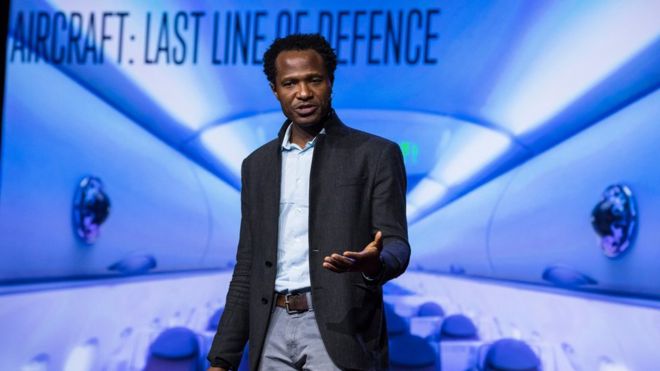
| Oshi Agabi envisages airports that will need no visible security system allowing people to just walk on to planes |
Nigerian Oshi Agabi has unveiled a computer based not on silicon but on mice neurons at the TEDGlobal conference in Tanzania.
Eventually the modem-sized device dubbed Koniku Kore could provide the brain for future robots.
Experts said that making such systems mass-market was challenging.
All of the big tech firms, from Google to Microsoft, are rushing to create artificial intelligence modelled on the human brain.
While computers are better than humans at complex mathematical equations, there are many cognitive functions where the brain is much better: training a computer to recognise smells would require colossal amounts of computational power and energy, for example.
Mr Agabi is attempting to reverse-engineer biology, which already accomplishes this function with a fraction of the power it would take a silicon-based processor. "Biology is technology. Bio is tech," he says. "Our deep learning networks are all copying the brain."
He launched his start-up Koniku over a year ago, has raised $1m (£800,000) in funding and claims it is already making profits of $10m in deals with the security industry.
Koniku Kore is an amalgam of living neurons and silicon, with olfactory capabilities baically sensors that can detect and recognise smells. "You can give the neurons instructions about what to do - in our case we tell it to provide a receptor that can detect explosives."
He envisages a future where such devices can be discreetly used at various points in airports, eliminating the need for queues to get through airport security.
As well as being used for bomb detection, the device could be used to detect illness by sensing markers of a disease in the air molecules that a patient gives off.