 |
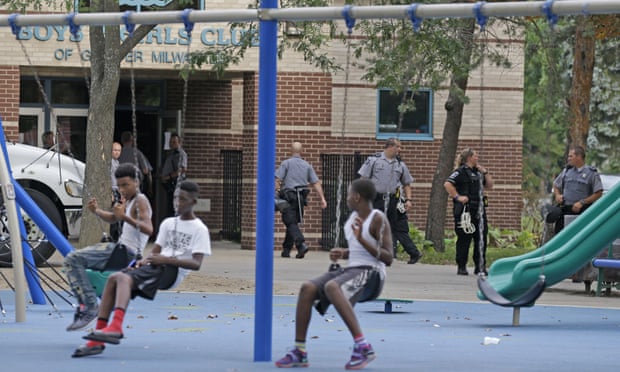
| Police prepare to close Milwaukee park following protests over the death of Sylville Smith, a black man who was fatally shot by police. |
hen Sharina Smith arrived back home in Sherman Park, Milwaukee on Wednesday after a decade living out of state, some things had changed irreversibly. Her 23-year-old cousin, Sylville Smith, was dead. Killed by a city police officer last Saturday after he ran from a traffic stop and allegedly pointed a firearm.
The gas station close to the family’s daily vigils was now a pile of rubble and ash, burned in the riots that followed Smith’s death. But of the many things in the neighbourhood that had remained constant, Smith spoke about one in particular: the crippling poverty.
“It hasn’t gotten any better. It hasn’t changed. People are outraged because of it. They get no attention, no help,” Smith, 32, said. “That’s why people were out on the those streets. My cousin’s death was one more thing.”
In this overwhelmingly African American neighbourhood, in one of America’s most racially segregated cities, more than 43% of residents live in poverty. The schools here are worse off. The employment prospects more bleak. Public transport is lacking. Rent is going up.
This summer tensions between local young people and police simmered following a spate of minor clashes inside the 20-acre park, which sits in the centre of the neighbourhood. Smith’s death proved to be the event that tipped some people over the edge.
“It used to be different,” said state assemblyman David Bowen, a 29-year-old African American who has lived in the neighbourhood his entire life. He strolled along the neatly kept grass and pointed to the prime housing stock, built during the industrial boom years of the 1920s, which faces inwards towards the park.
Once owner occupied, these units are now mostly rented and many are in a state of disrepair.
“Decades ago it was the norm to make enough that you weren’t thinking about whether to buy your food or pay your rent.”
Like many major cities in America, including Detroit, Pittsburgh and Buffalo, Milwaukee saw an ascendancy through a manufacturing boom in the mid-20th century, followed by a sharp slump accompanied by urban decay. In the wake of globalization, domestic competition and industrial automation, these cities have experienced high crime rates, high unemployment and increased drug addition.
The Sherman Park neighbourhood was once celebrated as a standout success within Milwaukee during the 1970s for its racial integration and multicultural community-building.
African Americans who had moved into the area among tens of thousands driven to Milwaukee to escape the south’s racist violence mixed among the existing Irish-Catholic, German-Lutheran and Jewish communities.
Problems persisted; life was by no means perfect. But things felt better than in other neighbourhoods nearby.
Sherman Park’s school district stood alone within the city by opposing racial segregation and busing while Milwaukee fought to preserve it in the face of a federal court order in 1976, according to Paul Geenen, a former long-time resident and local historian.
Mixed-race soccer teams and block parties were effective threads tying the community together. But now the public schools in Milwaukee are almost as segregated as they were five decades ago.
“We were respectable. It was mixed, white and black, we all got along together. I had black and white classmates at school,” said 61-year-old Geoffrey Pugh, an African American who was born in the neighbourhood and spent decades here before moving away in the 1980s only to return four years ago. “We’ve got a lost generation now. Babies raising babies.”
Two key developments in more recent decades radically altered the neighbourhood’s course, according to Geenen. One was the sharp decline in local manufacturing industries that had provided steady employment for a racially diverse blue-collar population, including for many black men.
Between 1979 and 1984 Milwaukee lost 50,000 jobs more than it did during the Great Depression.
Most prominent was Allis-Chalmers, a heavy machinery manufacturer with roots in Milwaukee reaching back into the mid-19th century.
The firm employed 20,000 people at its peak but collapsed in the mid-1980s amid rapidly rising international competition and corporate missteps.