 |
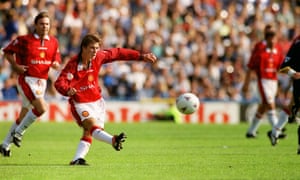
| David Beckham scores against Wimbledon at Selhurst Park in 1996 |
Wednesday was the 20th anniversary of his goal from the halfway line against Wimbledon, a fork in the road that led to him becoming a cultural icon first and a footballer second. Probably an ambassador third.
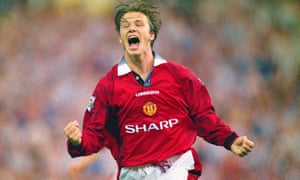 |
| David Beckham celebrates his superb lob against Newcastle in the 1996 Charity Shield. |
Although players had scored from inside their own half before, Beckham brought the genre into the mainstream and rocketed himself towards superstardom.
“I couldn’t have known it then, but that moment was the start of it all: the attention, the press coverage, the fame,” he wrote in his autobiography, My Side. “When my foot struck that ball, it kicked open the door to the rest of my life.”
The joy of Becks
David Beckham was not born with golden balls. His hero was Glenn Hoddle but he had just as much in common with Kevin Keegan, a self-made great. “From the moment he first laid boot on ball,” wrote Sir Alex Ferguson in My Autobiography, “David Beckham displayed an unbreakable urge to make the best of himself and his talent.”Although Beckham was a key part of the Manchester United team that won the FA Youth Cup in 1992, he was not high on the list of those expected to make it: Ryan Giggs, Paul Scholes, Nicky Butt, the Neville brothers and two other wingers, Ben Thornley and Keith Gillespie, were all rated above him.
Nor was he in the England Under-18 squad that so charmingly won the European Championship of 1993. Obstacles that would have broken so many other players had no impact on Beckham; in more ways than one, he spent his United career doing what others said he couldn’t. In the film The Class of 92, Butt says Beckham is “as mentally tough as anybody you’ll ever, ever, ever meet”.
He generally played in the centre of midfield in the youth team, spraying Hollywood passes and receiving almighty bollockings from the coach Eric Harrison when he got them wrong and charging optimistically from box to box.
Beckham could not only could run all day and all night but wanted to do so: when he was an apprentice at United, living in digs after moving to Manchester on his own at the age of 15, he would train in the morning and afternoon and then turn up in the evening to join in with the schoolboys.
Ferguson eased Beckham into the first team on the right-hand side of midfield, away from the muck and bullets. He made his debut as a substitute in the League Cup at Brighton in 1992, when he was 17, but did not appear in the league until 1995. A series of events that year opened doors for Beckham.
Gillespie, a revelation in his early first-team appearances, was sold to Newcastle as part of the deal to sign Andy Cole; the only reason Ferguson let him go was because of the foreigner rule in the Champions League, not knowing it would be abolished later in the year.
Then Andrei Kanchelskis moved to Everton in mysterious and sinister circumstances. Darren Anderton turned down the chance to replace him, and Nottingham Forest would not sell Steve Stone.
That left Beckham competing with Lee Sharpe, an unnatural and reluctant right winger, and he was a regular by the end of the 1995-96 season as United overhauled Newcastle’s huge lead on the way to winning the Double.
He scored the winner against Chelsea in the FA Cup semi-final and two goals in the 5-0 victory over Nottingham Forest that helped tip Keegan over the edge. There was also a thrilling stamp of class in league goals against Chelsea and particularly the defending champions Blackburn, a chip on the turn that left Ferguson running around the dugout in his suit, eyes ablaze like a man who had seen a trailer for the next 10 years.
Beckham was nowhere near the Euro 96 squad – only the Neville brothers made it from the whole United team, never mind just the Class of 92 – and spent his summer on holiday in Sardinia, eating pasta every day and bathing in the realisation that he was now a bona fide Manchester United player.
While he was away, Karel Poborsky was wowing Ferguson with his performances on the wing for the Czech Republic at Euro 96. He gave Paolo Maldini a serious chasing in the win over Italy and beat Portugal in the quarter-final with that ingenious scoop. “His hair may well get on my nerves if I sign him,” wrote Ferguson in his season diary, “but he can definitely play.”
This is not to say Ferguson did not have plans for Beckham; he was ahead of the rest of the country in his use of rotation, and bought five players that summer the others were Ronny Johnsen, Ole Gunnar Solskjaer, Jordi Cruyff and Raimond van der Gouw to strengthen his pool with a heavy schedule in mind. “It’s about going for the Triple!” he chirped in Sky’s pre-season advert.
Whatever Ferguson’s plans were, Beckham soon altered them. In the Charity Shield against Newcastle, Ferguson named the same side that had started the FA Cup final which meant no place for Poborsky or Cruyff. United slaughtered Newcastle 4-0 and Beckham, both on the wing and in the centre after an injury to Butt, was electric. He made two and scored a fine lob.
His joyous celebration might seem excessive given the status of the game, until you remember that Beckham was a football nut who had just scored at Wembley for the first time.
In the early part of his career, Beckham celebrated all his goals in the same way, with a boyish smile that reflected his disbelief that he was scoring goals for Manchester United. Innocence is finite; Beckham’s would die within the week.