
 |
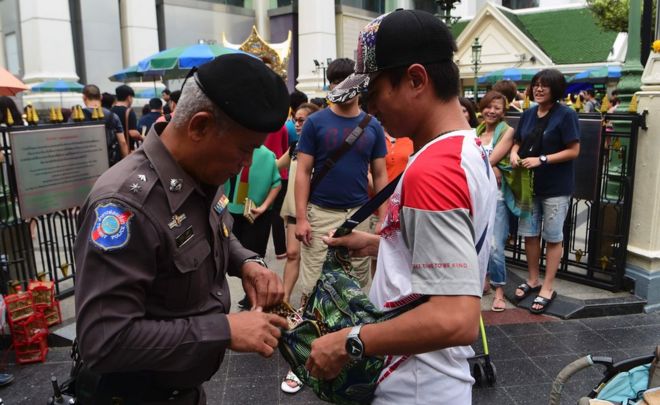
| Security has been stepped up at Erawan shrine in the wake of the recent attacks elsewhere in Thailand |
If the investigation of last week's
multiple bomb attacks in southern Thailand follows the pattern of that
into the bombing of the Erawan Shine in Bangkok exactly a year ago, we
are in for a surreal ride.
 |
| It is still not entirely clear who was behind the Bangkok shrine blasts |
|
The immediate response of the military authorities was to deny any possibility that this was a terrorist attack. The next response was to deny any possibility that it might be retribution for a controversial decision a month before to deport 109 Muslim Uighur asylum-seekers back to China, where they faced harsh treatment as suspected insurgents.
This despite the fact that the shrine was known to be popular with Chinese tourists.
Instead military spokesmen dropped heavy hints that their domestic political opponents - supporters of ousted Prime Ministers Thaksin and Yingluck Shinawatra - were to blame.
Even when two suspects were caught, both of them ethnic Uighurs, the Thai authorities initially refused to confirm their Chinese nationality, and insisted they were merely part of a people-smuggling gang frustrated over police operations constricting their business.
This official view has remained unchanged to this day, notwithstanding the discovery of large quantities of bomb-making materials in the same apartment where Bilal Mohammed, the first suspect, was apprehended.
But the police continued to try to link the attack with the opposition red-shirt movement. They stated last September that one of the key suspects was a known red-shirt activist, appropriately named Mr Odd, with links to a woman who was among 15 people believed to have fled to Turkey in the wake of the bombing.
His photograph was circulated, but then the police appeared to lose all interest in him. Neither did they make any visible efforts to get the 15 other suspects extradited from Turkey, despite the fact that one of them, a Uighur man named Abudustar Abdulrahman, who had flown out of Bangkok the night before the bomb, was believed to have played a central role in organising the attack.
Meanwhile the police put on a bizarre spectacle, awarding themselves a large pile of cash, equivalent to around $80,000, which had been raised as a reward for information leading to convictions.
The two detained suspects have since been indicted and held in a military base, with very few people allowed access to them.
Bilal Mohammed has been charged with placing the bomb under a seat in the shrine - the man caught on security camera videos that night - even though he looks quite different, and police had at first insisted he was not the man in the video.
He has denied the charge and has written a letter insisting he was only trying to reach Turkey, using people-smugglers in Thailand.