A cyberpsychologist is worryingly persuasive about the potential damage to children of a life onlin.
A Pioneering Cyberpsychologist Explains How Human Behaviour Changes Online;
and the potted bio, informing us that “Dr Mary Aiken is the world’s
foremost forensic cyberpsychologist” all clues indicating that this is
a book targeted at the US market, another addition to that sprawling
genre of books by folks with professional qualifications using pop
science to frighten the hoi polloi.
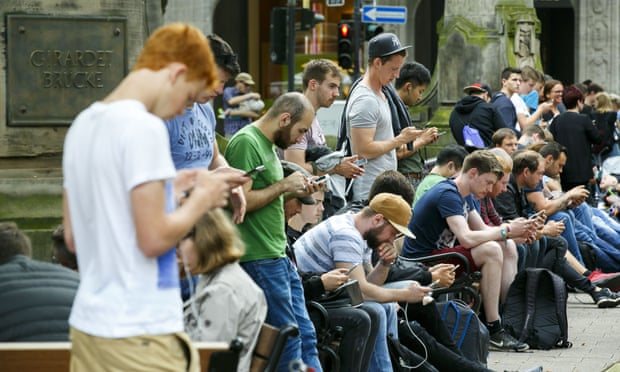 |
| People gather to play Pokémon Go in Düsseldorf last month |
At this stage, there can’t be many people who haven’t, at one time or another, fretted about this question. After all, the technology has invaded every aspect of our lives; it is changing social and private behaviour, having a disproportionate impact on our children and facilitating types of criminal and antisocial behaviour that are repulsive and sometimes terrifying.
And it is now also changing democratic politics: the most interesting thing about Donald Trump is how his narcissistic personality has found its perfect expression in Twitter – which is how we come to have an internet troll running for president.
But at the same time our public discourse about technology remains depressingly Manichaean with enthusiasts (and a formidably powerful global industry) extolling its wonders, while critics focus only on its manifest downsides. But this isn’t a proper debate: we are like two drunks in a bar arguing about whether oxygen is, on balance, a good or a bad thing.
The reality is that digital technology (like most technologies) is both good and bad. And, as with oxygen, it’s not going to go away. So the only rational way forward is to figure out how to live intelligently with it. But in order to do that we need to understand it.
The industry and its boosters have done a pretty good job in explaining the advantages. What we lack is an informed understanding of the problems, dangers and pathologies to which it gives rise.
This is the gap that Dr Aiken seeks to fill. As a psychologist, her prime interest is in the scientific understanding of online behaviour. “If I seem to focus on many of the negative aspects of technology,” she writes, “it is in order to bring the debate back to the balanced centre rather than have one driven by utopian idealism or commercialism.
My job is just to provide the best wisdom possible, based on what we know about human beings and how their cognitive, behavioural, physiological, social, developmental, affective, and motivational capabilities have been exploited or compromised or changed by the design of these products.”